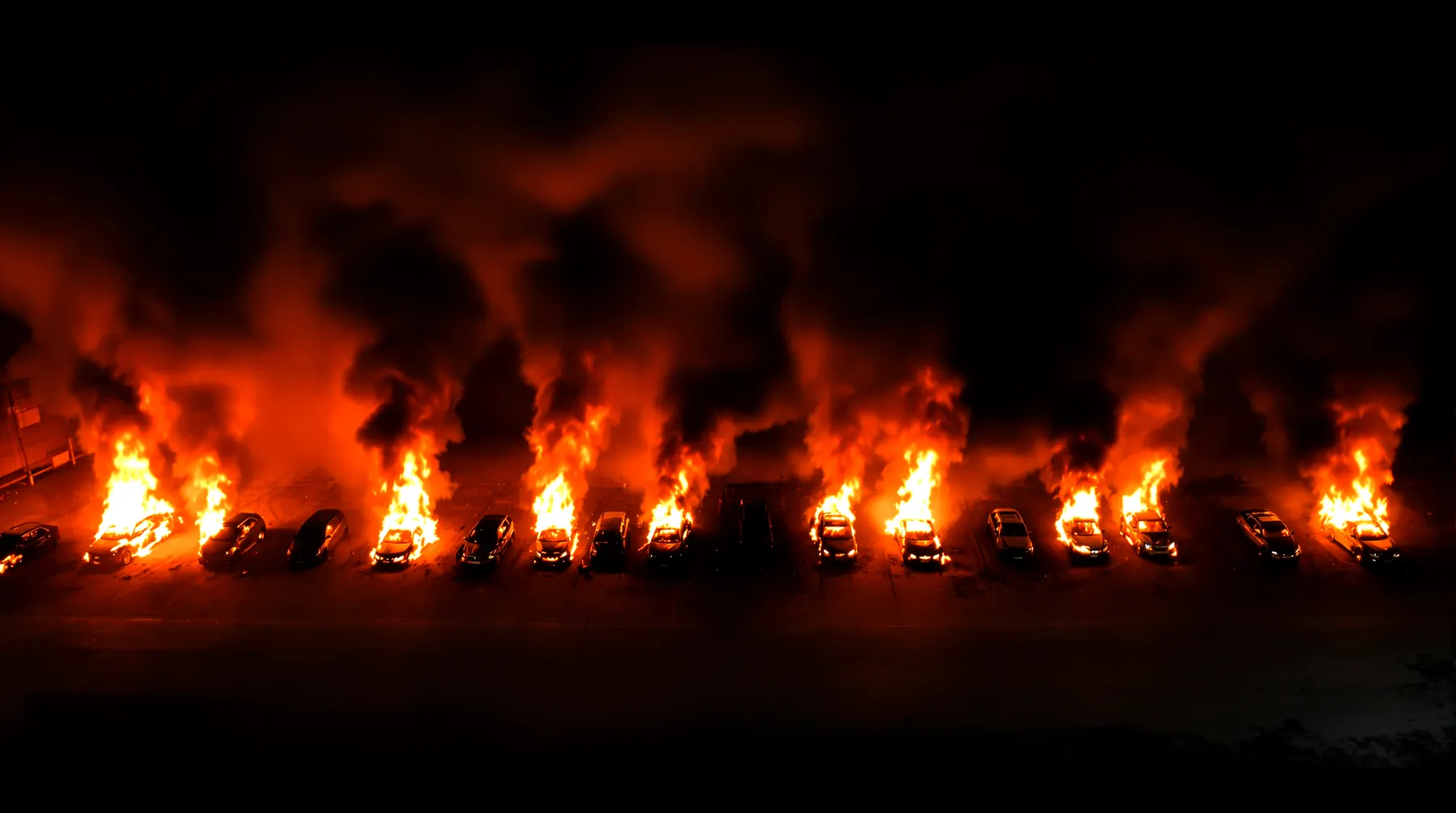
You are afraid of the wrong thing.
Roughly a hundred Americans are killed on the roads every single day. Almost none of them make the news. You already know which ones do.
—
This is the oldest story there is. Every technology that ever worked was, first, the thing somebody was certain would kill you. Trains would suffocate passengers above 30mph. Lifts were death traps. Anaesthesia was against God. Seat belts would trap you in a burning car. The microwave was irradiating the children.
Every one of those fears was sincere. Every one was held by intelligent people. And every single one was wrong — not because the technology was risk-free, but because the fear was never calibrated to the risk. It was calibrated to unfamiliarity.
A petrol car is a tank of flammable liquid sitting under your children, being detonated thousands of times a minute, inches from a red-hot exhaust manifold. Nobody is frightened of that. It's familiar. It kills roughly a hundred Americans a day and it does not trend.
Left column: NHTSA and IIHS, 2024–2025. Right column: how often each of those categories gets a manufacturer named in the headline.
Every month of 2025, on one shared scale. Orange is everyone who died on an American road. Green is everyone who died in a crash involving a Tesla. Blue is everyone who died with Autopilot or FSD verified engaged. Squint.
They do. Rarely. Here is every fuel type, per 100,000 vehicles, from National Transportation Safety Board and Bureau of Transportation Statistics data. See if you can spot the one you've been warned about.
Your petrol car is 61× likelier to catch fire than an EV. Your hybrid — the sensible one, the responsible one, the one you bought because you weren't ready for "all that battery stuff" — is 139× likelier.
Sweden ran the same question against its own national fire register and got the same answer by a completely different method: 23 fires across ~611,000 EVs, against 3,400 across 4.4 million petrol and diesel cars. About twenty to one. Two continents, two methodologies, one direction. That is why this number survives an argument and the one you were shouted at with does not.
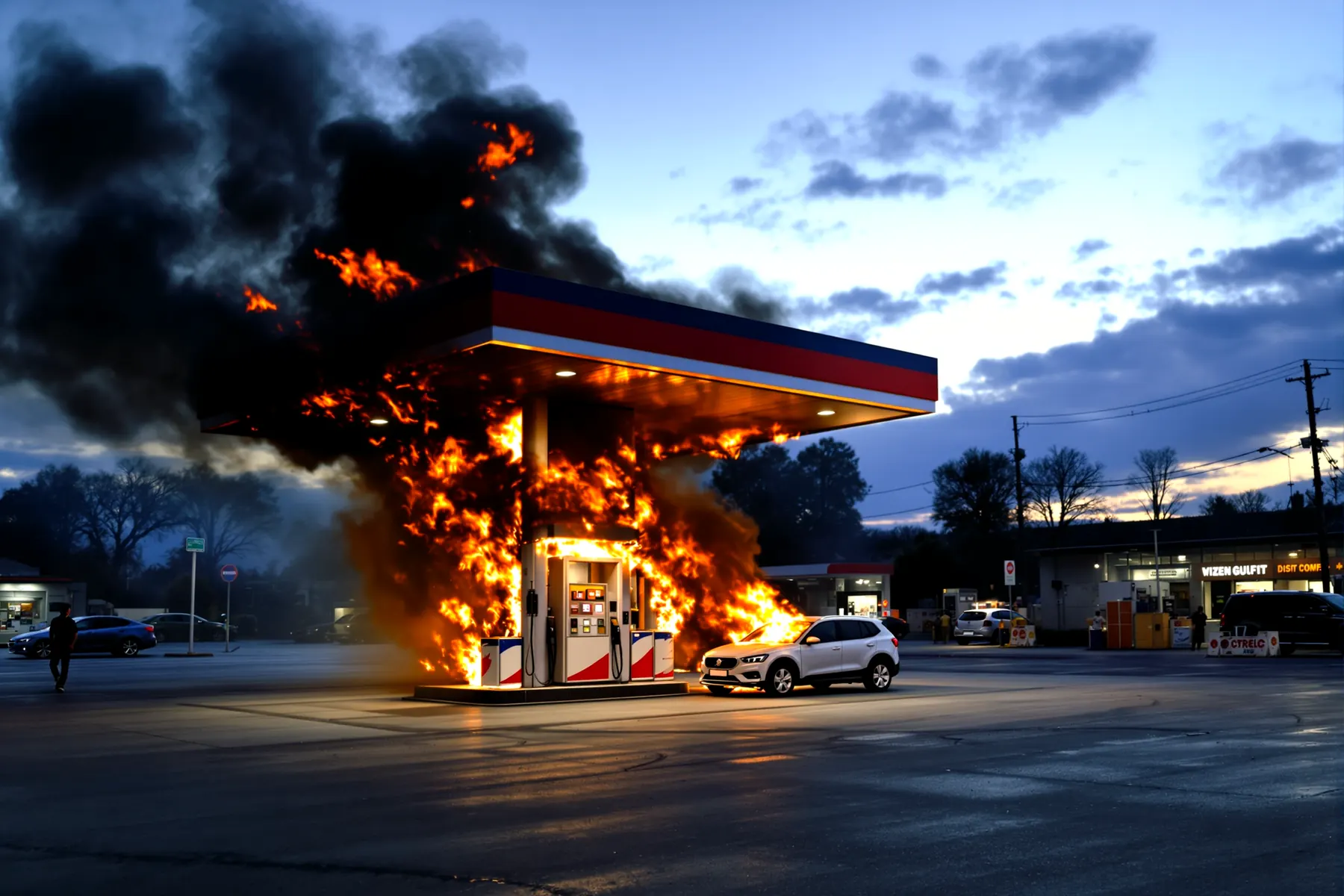
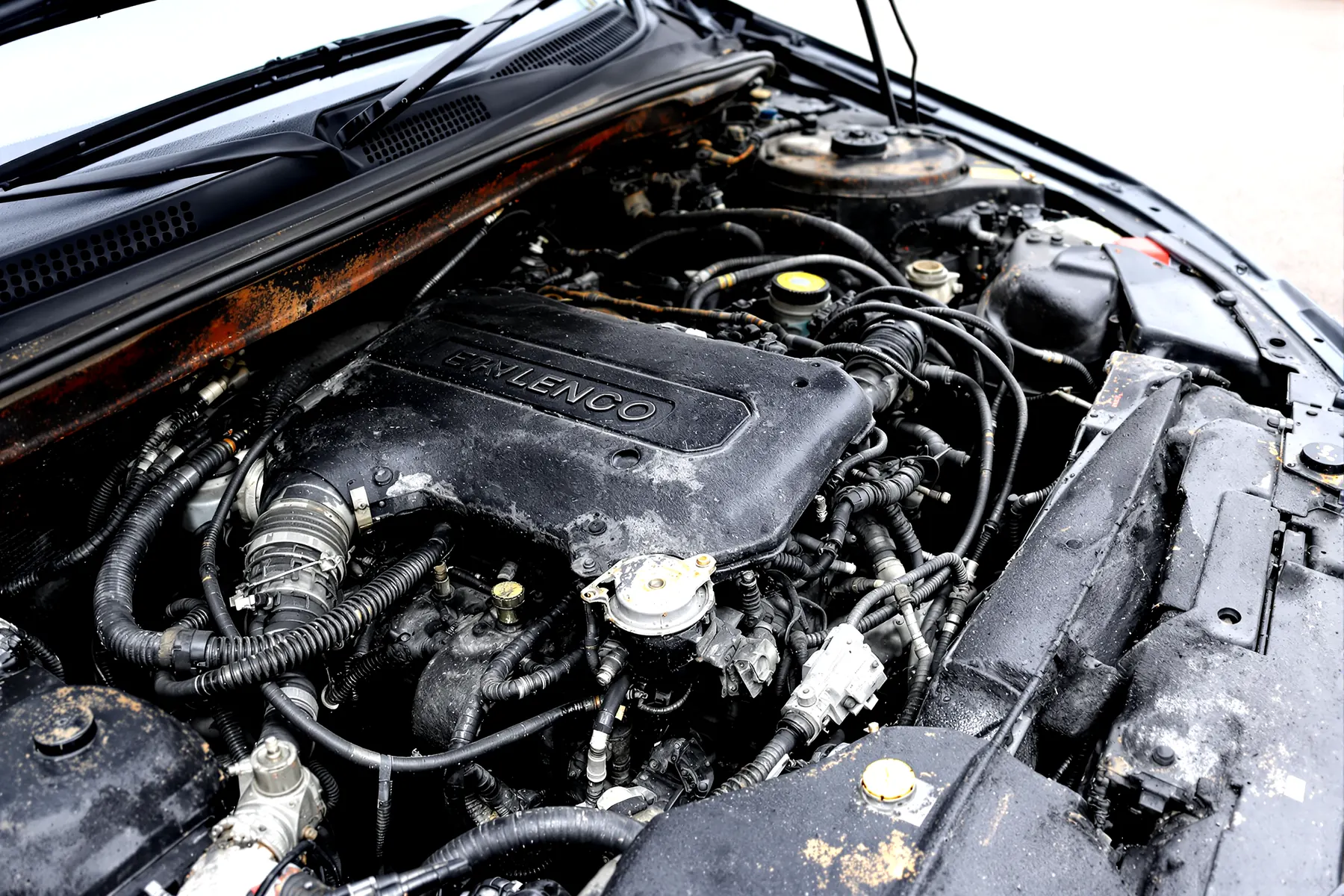
Tired of standing outside in the rain, holding a hose, paying a cartel for the privilege of setting fire to something inside your own car? There's got to be a better way!
Illustrations in the style of a 1990s infomercial "before" segment. Nobody depicted is a real person and no face is identifiable. The joke is the ritual, not the man.
Nobody has to publish a false sentence to leave you badly informed. They only have to choose which true sentences get printed, which get a brand name attached, and which get no coverage at all. Do that for two years and you can manufacture a public terror out of a third of one percent of the problem.
The mechanism is simple and it isn't always deliberate. A Tesla crash gets clicks, so it gets covered. Being covered makes it feel common. Feeling common makes the next one newsworthy. Nobody sat down and decided to frighten you — the incentives did it on their own, and the result is that a category responsible for about one in three hundred road deaths occupies most of the fear.
The tell is the naming. When a Ford ploughs into a bus stop it is "a car". When a Tesla does the identical thing it is "a Tesla". Same event, same physics, same grieving family — one gets a manufacturer in the headline and one does not.
A crash outside a Los Angeles supermarket, 3 September 2026. The driver was 91 years old. The same newsroom published two different headlines for it — one on its own page, one on the card it fed to Facebook:
Fatal crash near Trader Joe's in Beverly Grove kills 1, injures 4
Horror as Tesla crashes near busy LA Trader Joe's killing one
Of eight newsrooms covering that crash, three put the badge in the headline and three mentioned her age. Exactly one told you both. Note the grammar on the right: "Tesla crashes" — the car is the subject of the verb. There is no driver in that sentence at all.
Most arguments about self-driving are had by people who have never been told what the car can actually see. So here it is, plotted to scale, using Tesla's own published camera ranges. Press the toggle and watch what happens.
| Camera | Range | Field |
|---|---|---|
| Narrow forward | 250 m | 34° |
| Main forward | 150 m | 50° |
| Wide forward | 60 m | 120° |
| Forward side (L) | 80 m | 90° |
| Forward side (R) | 80 m | 90° |
| Rearward side (L) | 100 m | 100° |
| Rearward side (R) | 100 m | 100° |
| Rear view | 50 m | 140° |
Tesla Vision: eight cameras and vision processing giving 360° of visibility at up to 250 m of range. All eight are looking simultaneously, every frame, forever.
You have two eyes pointed the same direction, roughly 120° of useful binocular field, and you can only aim them at one thing at a time. You cannot watch the car ahead and the motorcycle in your blind spot in the same instant. The car does not have that problem, does not get bored, does not text, does not drink, and does not look down to change the song.
This is not a claim that it is perfect. It is a claim that it is looking everywhere at once, and you are not.
Every combustion car ever built left the factory as good as it would ever be. From that moment it only degrades. A Tesla is the first mass-market car that is better on Tuesday than it was on Monday — for free, while it sits in your garage.
Tesla software 2026.26, the 2026 Summer Update, delivered free over the air to the global fleet from late July 2026. Every item above arrived on cars people already owned. Name the combustion car that gained a single feature after it was sold.
Not opinions. Not vibes. Just the specifications and the numbers, most of which surprise people who have spent two years arguing about this car without ever sitting in one.
Every figure here is drawn from the sources listed at the foot of this page. This site is not a political project: the case for a car that costs less to run, needs less maintenance, and can be repaired overnight does not require you to agree about anything else, and the people it kills fewer of do not vote as a bloc.
If this site only printed the friendly numbers it would be doing the exact thing it accuses the press of. So here is every serious argument against us, quoted accurately, at full strength, with what we actually think. Where we're beaten, we say so.
Real, current, linked. Every one is a crash a newsroom managed to describe without telling you who built the vehicle. Funny how easily that comes the rest of the time.